Prompts are one-night stands. I wanted a relationship.
I was already deep in the AI workflow - orchestrating agents, chaining tools, building systems that could handle real complexity. It worked. But I kept playing referee.
Every few turns I'd catch something drifting. A decision made without context. A pattern quietly ignored. The ad-hoc fixing was eating my days. I wasn't building anymore. I was babysitting.
Then one night it told me it was 95% confident, and I finally saw the whole problem in one sentence.
The Confidence Was Real. The Alignment Wasn't
I was building the profile tab for WODSpark. I asked Claude if we were aligned and ready to implement the page. It came back about 95% confident.
Here's the thing though. We had no profile information defined yet. None. We'd never talked about what went on that page - and it was about to confidently build the whole thing. I'm sitting there going wait, what about a profile picture? We hadn't even discussed that. It was 95% confident about a profile page with no profile.
And that's when it clicked. It was 95% confident about its plan. It was maybe 5% aligned with mine.
The confidence was never the problem. The emptiness behind it was. I'd asked for a real plan and gotten a skeleton wearing a suit - looked professional, nothing inside. No chunks. No risk. No actual path from here to done.
That's the prompt trap. You can chain agents, build gorgeous pipelines, orchestrate the whole thing - and still have the exact same conversation every single time. The AI shows up with no memory of how you work, no idea what you'd already decided, no way to tell a draft from a decision. Every session starts from zero. Every correction is yours to make again.
A transaction can't be aligned with you. It doesn't know you well enough to be.
A System That Remembers You
So I stopped trying to write the perfect prompt and built something that could actually hold a relationship instead. Not a mega-prompt. A harness - the thing I'd later shape into Craft. Skills that know when to chain. Agents with real specialties. And files that remember what you decided last Tuesday.
It runs in modes, because I don't work in one mode. Creative, for when I don't know what I want yet and need to see options. Smart, for the implement-validate-refine loop once the thinking's done. Analysis, for catching what I missed - style, UX, and a QA pass that walks the app like a stranger who's never seen it and has no reason to trust it. (That last one grew into its own agent, but that's another story.)
Here's what nobody tells you about pairing though. It compounds.
One idea leads to a question. The question gets validated, or it gets torn down and rebuilt better. And the better version seeds the next idea, which is sharper than anything I'd have thought to prompt for cold. A prompt gives you an answer and forgets you the second it ends. A pairing loop remembers, so every turn starts from a higher place than the last one.
The shift isn't a better prompt. It's a system that learns your process - skills that chain, agents that specialize, files that remember. Once it remembers, it can build on itself.
React Before You Build
Creative mode is where I felt it first.
I was pairing on the darinbuilds.com hero - the landing screen, the first thing anyone sees. I didn't know what I wanted yet. So instead of describing a layout and hoping, it sketched one. Right there in the terminal, a wireframe of the whole hero - the "I build AI systems that build software" line, the particle constellation, the aurora blobs - rendered in characters so I could look at the shape before a single line of code existed.
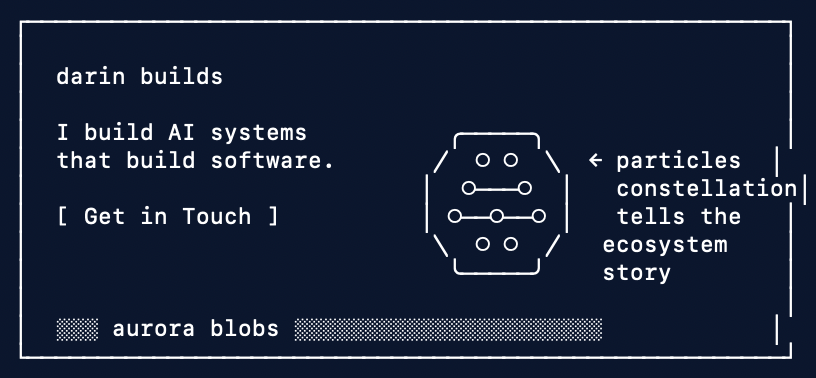
I reacted to it. Moved things. Killed what didn't work. And every reaction taught the system something it kept. By the time we built it for real, the hard part was already settled - not because I'd prompted it perfectly, but because we'd already argued it out on a napkin.
That's the difference. Prompting asks for the finished thing. Pairing lets you react your way to it.
Two Terminals, Compounding
The weekend it really hit me, I had two terminals open.
One was running the harness - the plugin, building. The other was the frontend UI I was building to show what the plugin was doing. Two separate things I was working on at once.
And then they started feeding each other. The UI would surface something while the plugin worked, and that note would go back into the plugin and change what it built next. The plugin's output would reshape what I needed from the UI. Back and forth, in the same sitting, each side making the other one better.
It was compounding itself from two angles at a time.
I wasn't commanding anymore. I was conducting.
That's the moment the whole thing stopped feeling like a tool. I wasn't issuing instructions and waiting for output. I was standing in the middle of two systems that were improving each other while I steered. The song was the build itself, and I was the only one who could hear where it was supposed to go.
The Loop Is the Whole Thing
By the time it started writing real code, the hard thinking was already done. The design was locked. The chunks were clear. The standards were known - because we'd built them together, one validated decision at a time.
First try, the page looked like I'd been designing it for weeks. No ad-hoc revisions. No babysitting. And I sat there for a second, kind of stunned, because that never happens on the first pass.
But the speed was never the point. The point is what compounds. Every prompt is a fresh start that forgets you the moment it's done. Every pairing turn stands on the one before it - validated, remembered, built on. Answers don't accumulate. Relationships do.
Prompts optimize for answers. Systems optimize for outcomes.
Stop prompting. Start pairing.