This site wasn't the plan. There wasn't really a plan.
But you know how it goes. You build one tool. Then you need another tool to help the first one. Then a third because the first two keep forgetting things. And then one day two terminals are passing messages to each other over a shared database and you're like... when did this happen?
Here's the honest part. I can't even tell you what the first tool was.
I've tried. Was it the craft story and implement commands? That's a whole workshop now, so calling it "the first tool" feels wrong. The implementer agent? A skill? I genuinely don't know what I'd call tool number one, lol.
And that right there is the whole point. If I'd set out to build an ecosystem, there'd be an obvious first product. A version 1.0. There isn't. Because I was never building an ecosystem. I was just solving the next annoyance in front of me, and the earliest thing was a couple of harness commands that have since grown into the whole structure I work through every day.
I'm getting ahead of myself though.
A Terminal, Not a Canvas
I didn't start in Figma. Didn't even open a browser. Everything started in a terminal - which sounds insane for a visual project, but honestly it changed everything.
The terminal became the canvas. Ideas took shape as ASCII wireframes. Design decisions got locked before a single pixel hit the screen. Here's what the hero section looked like before it was the hero section.
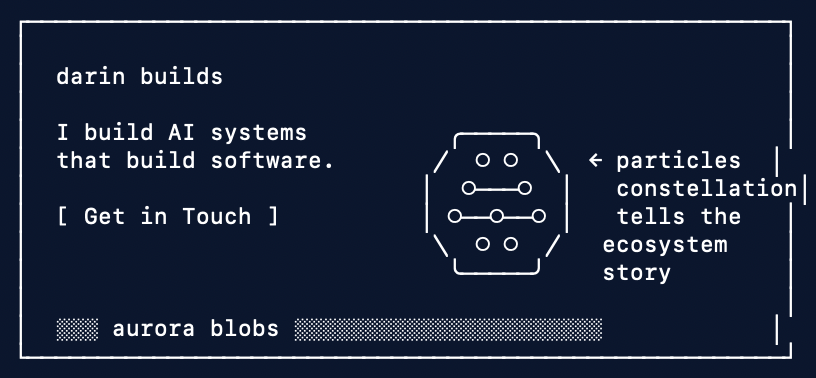
That whole thing came from a terminal conversation. No whiteboard. No Figma. Just text.
Most AI tools take instructions and spit out code. This was different though. The system already knew what I like - deep blues over purple, spring physics over linear easing, editorial pacing over cramming everything in. It didn't ask me what I wanted. It showed me what I'd want, and it nailed it.
That's not autocomplete. That's something that's been paying attention.
The Moment I Saw the Light
Here's where it gets weird though.
I had two terminals open over a shared database, both grinding on stories. And one of them sent a message up the chain. Not to me. To the part of the system that could actually do something about it.
It said something like - verification failed on two different stories for the same reason, suggest adding one line to the planning skill to stop it from happening again.
Read that again. A worker hit the same wall twice, figured out the pattern, and proposed a fix to the process itself. Then sent it upward to where it could be acted on.
That's not a tool returning output. That's a report moving up an org.
I sat there and watched it happen. And it wasn't a "huh, neat trick" feeling. It was more like... oh. Oh, this is powerful. This can become something.
I'd designed the conditions for it. The shared database, the messaging, the rules for how they talk. I just hadn't seen the shape of what those conditions added up to until one of them passed a note up the chain like an employee flagging a process problem. Nothing got away from me. The opposite. I saw, for the first time, exactly what I'd been building.
It looked like an org chart.
The Org I Didn't Know I Was Building
So I leaned all the way in.
That first spark - a terminal reporting up the chain - became a structure. A Director that drives a craft worker terminal. Above that, a CTO that manages my Directors. And here's the line I still can't believe I get to write. The CTO is my direct report.
I'm at the top. I have a CTO. The CTO manages Directors. The Directors drive the workers that write the code.
That's not a metaphor I'm reaching for to sound clever. That is literally how I do my day-to-day work now. I don't open eighteen terminals and babysit them. I talk to one person. The structure underneath handles the rest and reports back up to me.
It's not a company. I'm not incorporating anything, there's no payroll, lol. But it's shaped exactly like one. It's made of agents, every layer reports up to the layer above it, and there's exactly one human in the whole thing. Me. At the top. Every layer exists to report up to that one person.
Why the Layers Compound
Here's the part that makes it actually work, not just sound cool.
Every layer in that hierarchy adds a quality gate. The worker writes code, but a validator checks it before it moves up. The Director reviews the work before it reaches the CTO. The CTO has to be able to answer to me. Each handoff is a review.
So the quality doesn't just get delegated down the chain. It compounds back up it. By the time something reaches me, it's been through more checks than I could ever run by hand. Seventeen cycles of this. From an empty Next.js repo to the site you're reading right now.
1,897 tests. TypeScript strict mode. Almost everything went through the full pipeline - planned, chunked, implemented, validated. There were hotfix cycles early on, I won't pretend there weren't. But the further in I got, the more the structure caught corners before I could cut them.
Every checkpoint, every validation gate - that's the same Craft system the site showcases. The process built the product. The product demonstrates the process. Gets a little meta though
That doesn't happen by accident. It happens because the org enforces it. Nothing ships until it's been reviewed by the layer above it. The structure makes it almost impossible to cut corners, even when I want to.
When you don't cut corners for seventeen cycles, something weird happens. The site starts to feel handmade. Not despite the org - because of the discipline every layer enforces on the one below it
The Page That Proved It
If you haven't seen the AI Consumer Platform page yet - honestly go look at it. That's the page where you can see what the org actually produces.
It's an editorial narrative. Seven scroll sections that build from a quiet opening line to every tool in the ecosystem converging at once. The typography escalates. The spacing tightens. The gradient accents get more vivid as it climbs toward the climax. Then it resolves to two words. Coming soon.
Every piece of that page came up through the same hierarchy I just described. The prose, the escalation, the navigation, the social image - each one a worker's output, reviewed by the layer above it, moving up until it reached me. The page that shows off the system was built by the system. The site you're reading right now was still inside the org that made it.
What Ground-Up Actually Means
Honestly this might be the most honest thing I can say about it. I didn't set out to build an org. I just kept solving the next problem in front of me.
Built a tool. Needed another. Then they started forgetting things, so I built one for that. Then I needed opinions - actual technical opinions, not vibes - so I built one for that too. And then one of them passed a note up the chain and I saw the light.
I built a tool to help me write code. Then a tool to help it remember things. Then a tool to give it opinions. Then a tool to give it a personality. Then I gave them a way to talk to each other. And the day one of them reported up the chain, I looked up and saw I'd built an org chart with me sitting at the top of it.
I didn't plan an ecosystem. But somewhere around the fourth tool, I looked up and realized I was standing inside one. So I built it a home.
You're in it right now.